Aquatic Nature of the feline
Two monuments represent with evidence feline nature and its association with water: numbers 1 of Los Soldados and 6 of La Venta, named the Sarcophage.
The today lost Monument 6 of La Venta is the image of a feline whose aquatic nature is shown by the flowering of lilies that sprout from the higher part of its ribs.
Another example of the representation of aquatic nature would be constituted by Monument 1 of Los Soldados. A huge body of a humanoid feline sitting on its hind legs is the basis of a grand enigmatic face.
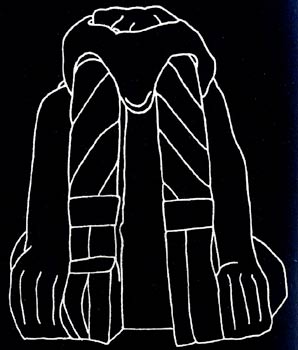
he wide upper lip typical of the Olmec mode of representing the human face, defines the exterior of the mouth. To its sides ascend, from the earth until penetrating them, two robust and complex volumes, composed of cylindrical and prismatic sections. Even if analogue in their general conditions, both have particular differences between them: in both, the cylindrical section engenders a series of diagonal parallel bands; but while in that of the left there are five, only four exist, and wider, in that of the right. The prismatic sections differ too.
Nobody, up to date, has tried any reasonable explanation of the nature and possible meaning of this volumes. The assention of the acuatic nature attributed to the feline in Mexican culture, gives way to an explanation with accents of illuminating truth: such volumes are the symbolically conventional representation of two different rivers in their point of birth, its course, and its outlet.
The prismatic parts could figure, with their respective geographical accidents, the places where they have their earthly sources; in turn, the cylindrical parts and the twisting that engenders the series of diagonal bands, would represent the fluvial currents that end in waters of greater dimensions, symbolized by that huge humanoid feline, which can be the rendering in image of a great river that harnesses the flows of two tributaries. Thus, supposing that the volumes in question represent rivers, but different rivers, both the analogy of the sections that compose them, as the individual traits that tell them apart, are justified.
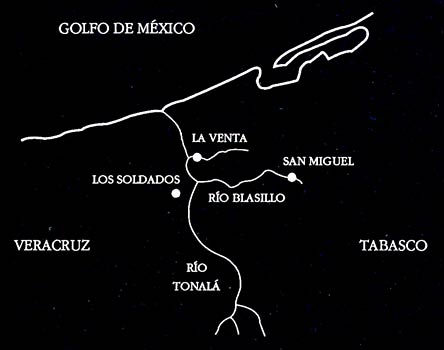
On other matters, it must be remembered that Los Soldados, site in which this monument was found, is not far from the Tonalá river, the course of which is enriched by the contribution of two eastern tributaries, almost parallel in their direction. Maybe that is the natural model that, in a symbolic fashion, acquires this monument of universalizable presence. The feline would represent, thus, the Tonalá river, and its tributaries would be the two volumes that get into the alveoli of its gum.