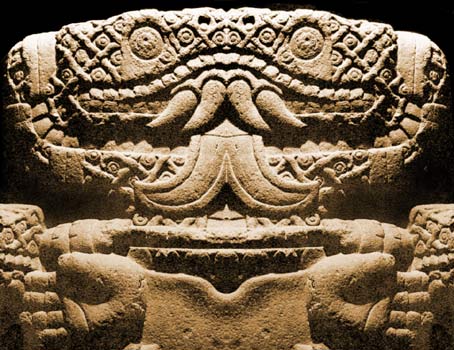
Aztec
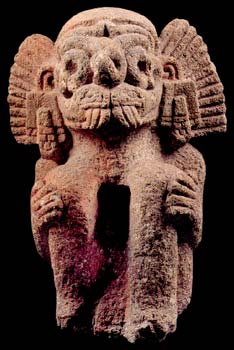
The gods transmuted into serpents join the first human being, in order to constitute the sum of the power that created the universe. The Olmecs, authors of such cosmogonic thought, expressed it artistically by means of two ophidian heads confronted in the upper lip of a man.
Heirs of the Olmecs, the men of Teotihuacan adopted, stylizing it, such a manner of figuration; they symbolized with his eyebrows the set of ophidian heads, and confronted those brows uniting them in the place of the mouth of a human face; thus they gave origin to their own representation of that sum of creative power, and gave it the name of Tlaloc.
With that name and that form the Aztecs took the same representation. But the Aztecs, who took the ancient Mexican culture to its summit, and to whom for the time being we owe the text that contains their cosmogonic thought, did not limit themselves to making clear to us the meaning of the face of Tlaloc; they added to such entity, representation of the maximum power, a body and illuminating characteristics.
The body is human; his joints, shoulders, elbows, hands, knees and feet are protected by skulls and serpents' eyes and mouths; that is why, to join him, the gods had to transmute into serpents.
The Aztecs took care to set clearly in writing the plastic forms of their cosmogonic conception. Here is the superb feline, representation of the waters of unknown creator, which preexist all; here is the first human being; his joints are garnered with eyes and mouths.
The gods have lowered him to the preexisting waters; they have seen him walk over them; while seeing his joints, they have felt awakening in them the need to create the world; to satisfy it, they will join him, transmuting themselves before into serpents.
In those images, the achieved union is seen. The body of the first human being remains the same, but his head has been substituted by the union of those of the gods turned into serpents. Those heads are represented by their upper jaws.
In relief, almost flat, those images of the highest power can be found. To represent it in indubitable fashion, the Aztecs are to figure it in volume, endowing it with magnificent attributes. Here is Coatlicue.