Altar 4 from La Venta
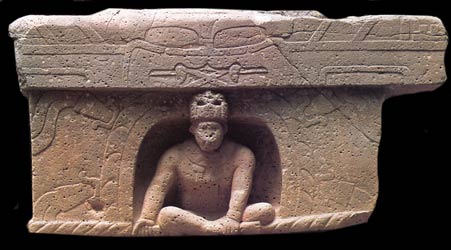
Having established that water can find in the feline the nature that symbolizes it, it will now be possible to undertake reading the frontal part of Altar 4 of La Venta which, in what regards the expression of the cosmogonic idea of ancient Mexico, is undoubtedly the most important Olmec monument preserved.

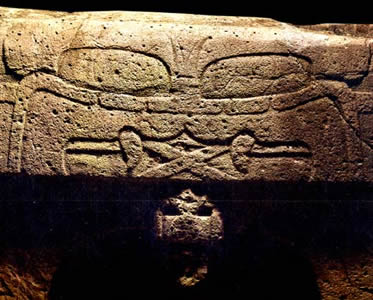
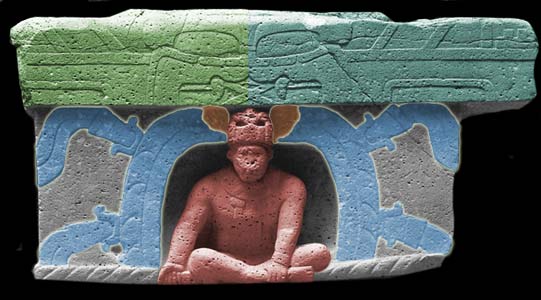
Two superimposed rectangles compose the frontal view of the monument; narrower and longer, the top one has in its central part the figure of two great heads of serpents facing each other; turned upwards, their bifid tongues show their profiles in brief, acute shapes; between their fangs appears a quincunx with the appearance of two crossed bands.
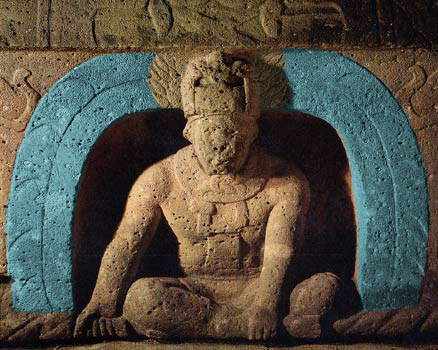
In the middle part of the lower rectangle, just bellow the meeting point of the two serpent heads in the upper one, is located a human image: it is seated with crossed legs and extended arms, and appears to be coming out of a concavity, the borders of which, as the rest of the surface of this rectangle, constitute undoubtedly the representation of aquatic nature.
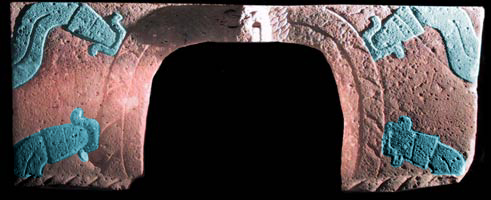
In effect, to both sides of the border of the concavity, ascend, in opposite senses, a series of parallel bands, analogous to those that, in the frontal columns of Monument 1 of Los Soldados, figured currents of water, and from them seem to leave, from vases as chalices, four undulating bands clearly figurative of liquid trajectories.
The whole sense of what is represented in the frontal part of this Altar 4 of La Venta becomes evident: out of the aquatic mass is born the human figure, to which the double presence of the divine serpents allies itself; the creative power of the feline is, then, integrated; three natures, feline, ophidian and human, symbolize it with their union; the quincunx set between the fangs of the serpents, reinforces and explains this meaning, creation. The nature of the bird, symbol of such process, is also present. If the rest of the headband of the man is observed, it in it will be seen, on both sides of his head, a series of feathers, instruments of flight.
Thus is integrated, in its entire plenitude, the cosmogonic concept of ancient Mexico. It would be arduous for alphabetical scripture to express it more clearly.
Explore the Altar 4 from La Venta