Olmec Faces
In the faces that come from the Olmec culture, that culture in which can be found integrally manifest the cosmogonic thought that funds the unity and greatness of all the ancient Mexican culture; in the faces, then, that come from it, its major secret is revealed: their upper lip widens to figure the profile of two serpent heads that face each other.
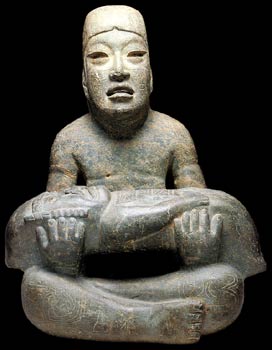
As if the Olmec had decided to efface any doubt about the meaning of the fore-mentioned widening of the upper lip in their representations of the human face, during a late period, their culture about to disappear, they sculpted this face, which is kept at the Museum of Anthropology in the University of Veracruz.
The intention cannot be clearer: the typical trapezoidal Olmec mouth is there; there, in the widened upper lip, the profile of two confronted serpentine heads takes relief; united to the human being, represented by its face, the two divine serpents constitute the unit that will create the universe.
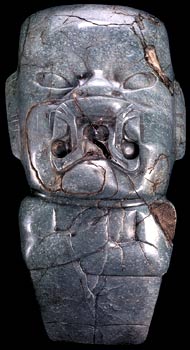
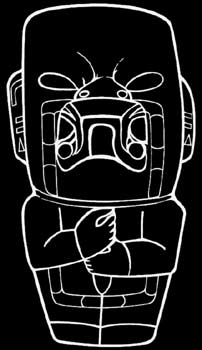
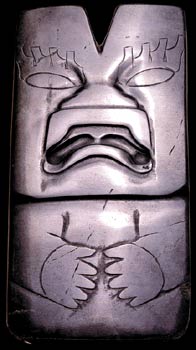
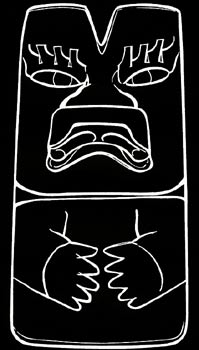
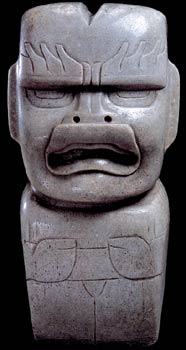
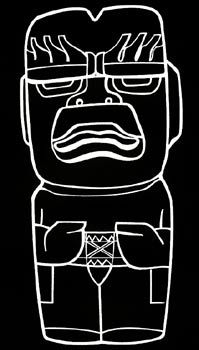
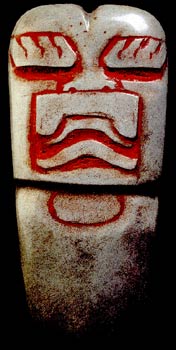
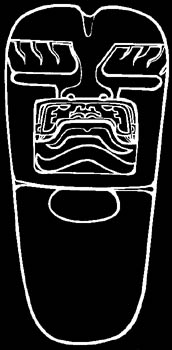


Two are the main manners in which such faces are shown to us: the naturalistic and that of stylized traits. Example of these last, are given to us in the so-called votive axes. All the traits in them are variable, except one: analogue to the mentioned face in the Museum at the University of Veracruz, its mouth is trapezoidal and widens in the upper lip; it is, thus, a sort of symbolization of the two ophidian heads face to face.
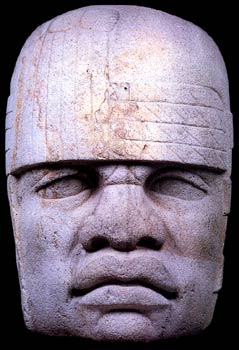
Naturalistic faces find their best example in the so-called colossal heads, with their widened upper lip. Three of them openly establish what is being signified with such a widening: one, the most antique, number 5 of San Lorenzo, and the other two, numbers 2 and 3 of La Venta. That of San Lorenzo, almost perfectly preserved, has the upper lip clearly sculpted in two sections, symbolic figuration of the two serpentine heads; the same figuration can be seen in number 2 of La Venta, in spite of their pitiable state of preservation.
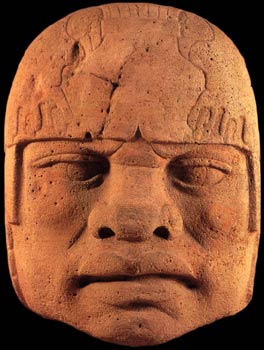
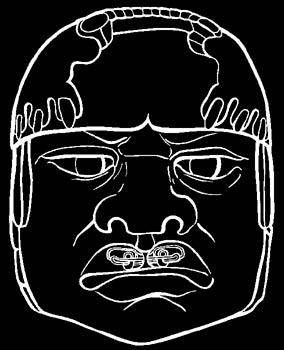
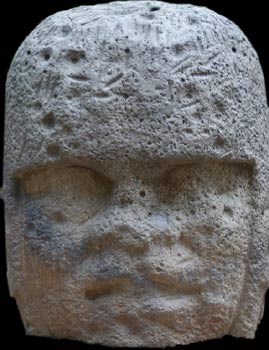
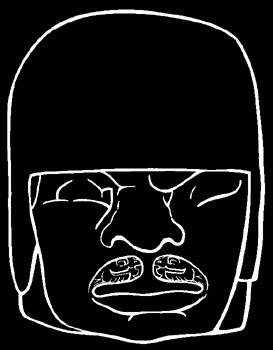
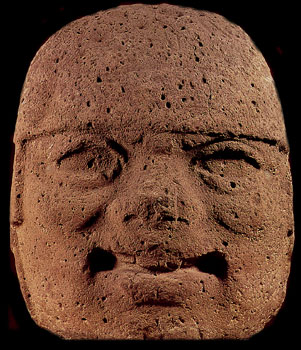
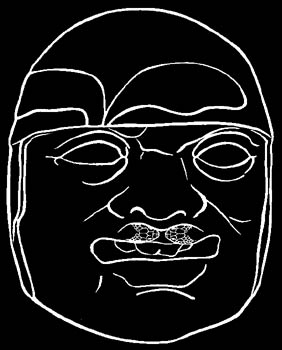
If after observing those three faces the rest of the colossal heads are examined, it can be noticed that the same is symbolized in their upper lip.
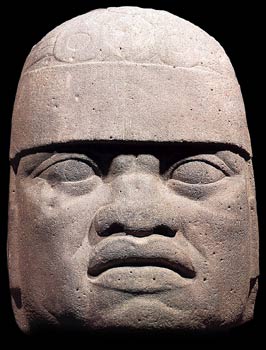
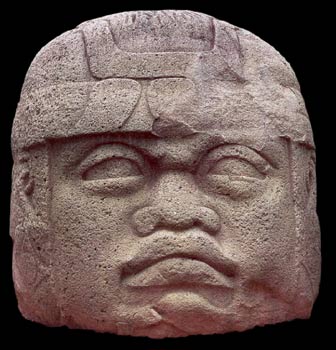
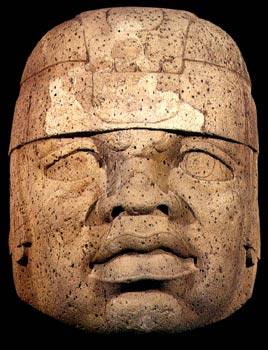
Example of a naturalistic face is a complete figure, the so-called Prince of the Miracle Cross; of a stylized trait face in a figure of that characteristic, is Monument 10 of San Lorenzo. Being the stylizing of the facial traits the means by which the Olmec expressed the degrees of manifestation of human essence, it is possible to understand, thus, that the Prince of the Miracle Cross is an image of pure humanity, whose aspiration to higher levels is signaled by the width of the lip over his mouth.
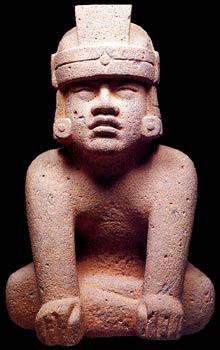
Monument 10 of San Lorenzo, itself too, would be the representation of the ripeness of the creative essence of man, at its greatest splendor. Time is set, it stops elapsing, and man transmutes into pure eternity.
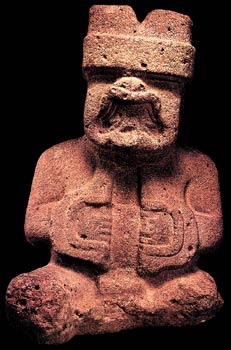
Thus then, through what they set in their images, it can be noticed that the Olmecs considered that the faculty of intervening as matter and motor in universal creation, was the essential condition of man; necessarily and under any circumstance, man considered himself the creator. And given that the universe, with his intervention, was already done, his power of creation would manifest itself uninterruptedly in the task of preserving and orienting it to its highest perfection.