Aztec
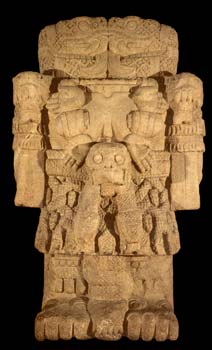
This monument was created by the Aztecs in the height of their glory. In it is summarized the idea expressed multiple times in the images of Tláloc; that is, that the human being, after awakening in the gods the impulse of creation, gives them, with his own body, the matter needed to execute it.
Thus the mentioned images represent the precise moment previous to the creation of the universe; the maximum condensation of matter itself which, exploding, is to originate it. Now, at the monument we see here, such idea finds artistic arguments which make it stronger and complement it. Let us see it again.
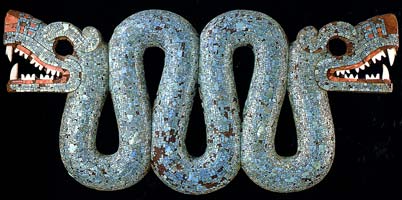
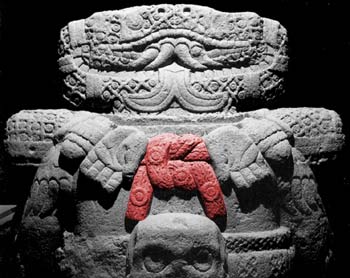
Let us notice that from her neck hangs a string which threads a series of alternate hands and hearts which, in its middle, has a skull. This is traversed by a serpentine belt which, in the middle of its posterior segment, goes through another one which is its twin.
The belt forms a unit with the string which threads the mentioned hearts and hands, string which consists of a current of blood, as can be seen in the knot that ties it over the nape.
The matter which constitutes this knot is a liquid; this is signaled by the wavy and parallel lines that, in its center, run through it in all its directions; and it is a precious liquid; that is indicated by the double round jewels that illustrate it in its stream. A bejeweled liquid, then; that is, a precious water; the precious water, that is to say, blood.
Of this sort, what unites the elements of the string amongst them is the life rendering flow of a sanguine river, which acts running through them and the serpent of the belt, getting the light of perpetual powers while crossing, upwards and downwards, the dome of the central skulls.
Thus, we have here the representation of hands, tools of all material creation; of hearts, organs that with their beating create the movement of blood that creates life; of skulls, on the one hand containers of the will and of thought, which create things immaterial; on the other, symbols of what survives the decay of the body; that is, of life that does not end.
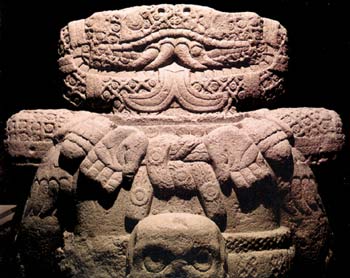
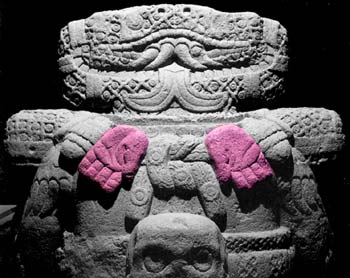
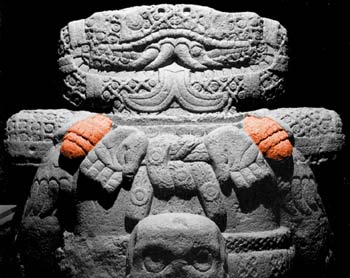

Finally, the beating of hearts, while giving impulse to the blood of the aforementioned string, with the unceasing cycle of circulation gives life to the effectiveness of the creative functions of hands and skulls, which are alive as the condition of their eyes demonstrates. All are, thus, creative faculties, the representation of which reinforces what is expressed by the union of the serpents and the human being, center of the monument.
And there is more. A numerous set of elements that are present in it develop the same meaning: a set of feathers, braids, rattles, sea shells.
Feathers, expression of flight in ascent; braids, as stairs which ascend and descend; rattles, creators of the sounds of cosmos; sea shells, with their central spiral, which engenders the possibility of an infinite succession of advancement and retrocession, and at the same time the essence of the form of the ear lobe, which in hearing justifies the existence of the rattles; born from chaotic waters, the sea shells now create their manifest order.
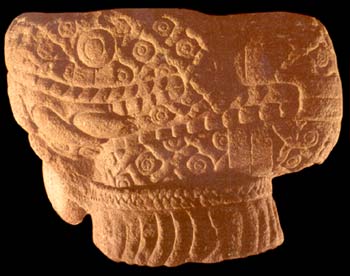
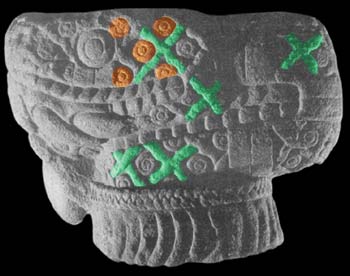
And circles, jewels of the perfect order created, can be perceived, and hardly numerable quincunxes, now pure, as in the scales of the great serpents, now composing the sign of creative movement, like in the knot that over the nape gives way to the blood stream, or in the braiding of the bodies of the skirt's serpents.
Creative expression as a whole, this monument turns out to be the explicative synthesis of the concept which, from its Olmec origin, states the supreme function of the human being as the impulse and the matter for universal creation and, therefore, as worthy of the task of preserving the created universe and exerting himself to take it to its perfection.